
 English (UK)
 English (US)
 Deutsch
 Français
 Italiano
 Español
 Português
 Nederlands
 Dansk
 Norsk
 Svenska
 Suomi
 Eesti
 Latviešu
 Lietuvių
 Polski
 Čeština
 Slovenčina
 Magyar
 Slovenščina
 Hrvatski
 Srpski
 Română
 Български
 Ελληνικά
 Türkçe
 Українська
 中文
 हिन्दी
 Русский
Scribner Decimal C – the log rule of the western US
A rule built by drawing boards into circles, today the standard for softwood logs in the western United States.
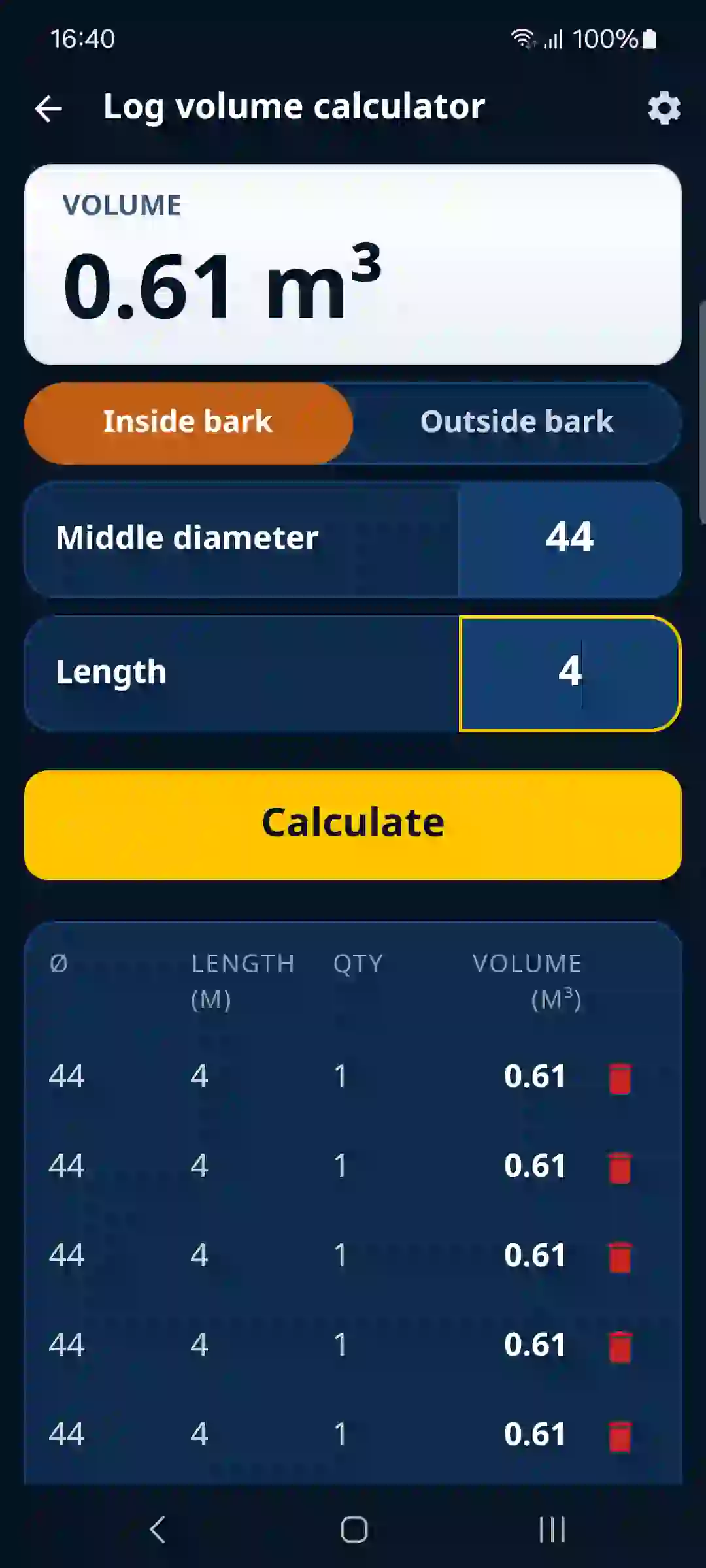
What is the Scribner Decimal C?
The Scribner log rule gives log volume in board feet from the small-end diameter and the length. It was created by drawing 1-inch boards with a ¼-inch kerf into circles of different diameters. The Decimal C version rounds the result to tens of board feet and drops the last zero.
Formula
BF ≈ (0.79 · D² − 2 · D − 4) · L / 16
The original rule is a table; the formula is only an approximation. D = small-end diameter in inches, L = length in feet. Decimal C rounds to 10 BF – a value of “16” means 160 BF.
Worked example
A log 16 inches at the small end and 16 feet long scales 160 BF by the Scribner Decimal C table (written as 16).
Where it is used
The western United States and Canada, mainly softwood logs. The USDA Forest Service uses it for timber sales in the West.
Frequently asked questions
Why does Scribner have no exact formula?
The rule was made by drawing boards into circles, not by calculation. The official rule is therefore a table; formulas exist only as approximations.
What does “Decimal C” mean?
Table values are rounded to tens of board feet and the last zero is dropped. So 16 means 160 BF.
How does Scribner differ from International ¼″?
Scribner ignores log taper, so it gives less on long logs. A 16″ × 16 ft log scales 160 BF by Scribner and 180 BF by International ¼″.