
 English (UK)
 English (US)
 Deutsch
 Français
 Italiano
 Español
 Português
 Nederlands
 Dansk
 Norsk
 Svenska
 Suomi
 Eesti
 Latviešu
 Lietuvių
 Polski
 Čeština
 Slovenčina
 Magyar
 Slovenščina
 Hrvatski
 Srpski
 Română
 Български
 Ελληνικά
 Türkçe
 Українська
 中文
 हिन्दी
 Русский
Timber and forestry glossary
Units, measurements and terms you meet when scaling logs, selling timber and using TIMBERPOLIS.
- Solid cubic metre (m³)
- One cubic metre of solid wood with no gaps. The basic unit of log volume in Europe, stated over or under bark.
- Stacked cubic metre (stere)
- One cubic metre of stacked wood including the gaps between pieces. For firewood, 1 stere is roughly 0.6–0.7 m³ of solid wood, depending on length and stacking.
- Loose cubic metre
- One cubic metre of loosely dumped wood, such as split firewood or wood chips. It contains even more air than a stere.
- Board foot (BF)
- The North American unit of sawn timber and log volume: a board 1 × 12 × 12 inches, i.e. 1/12 of a cubic foot. Log volume in BF is calculated with the Doyle, Scribner or International ¼″ rules.
- MBF
- One thousand board feet (M = Roman thousand). The usual trading unit in the US and Canada, e.g. a price of $450/MBF.
- Log scaling
- Calculating the volume of a log from its diameter and length using an agreed rule or standard, such as Huber or Doyle, or national standards such as STN 48 0009 in Slovakia.
- Mid diameter
- The log diameter at half its length. Used by the Huber formula. Under the Slovak STN and Czech ČSN 48 0009 standards, diameters from 20 cm are measured twice at right angles and averaged.
- Small-end diameter
- The diameter at the small end of the log, usually inside bark. The US rules Doyle, Scribner and International ¼″ are all based on it.
- Over bark / under bark
- Volume or diameter measured including the bark or after deducting it. Trade is usually under bark; double bark thickness is deducted from the over-bark diameter.
- Trim allowance
- Extra length on a log (usually a few centimetres or inches) that is not counted in the volume. It allows the ends to be squared without making the log too short.
- Log (sawlog)
- A section of a stem cut to a set length, e.g. a 4 m sawlog. Each log is measured separately when scaling.
- Roundwood
- Delimbed stems and logs with a round cross-section, ready for sale or sawmilling.
- Taper
- The decrease in log diameter toward the top, e.g. in cm per metre. The International ¼″ rule assumes a taper of ½ inch per 4 feet.
- Kerf
- The width of wood removed by the saw blade in one cut. It affects sawn timber yield; International ¼″ assumes a ¼-inch kerf.
- Sawn timber yield
- The ratio of sawn timber produced to log volume. For softwood logs it is typically 55–70%.
- Overrun
- How much the actual sawn timber tally in board feet exceeds the log scale. It is high with the Doyle rule on small logs, because Doyle underestimates them.
- Girth
- The circumference of a log measured with a tape. Diameter is d = G / π. The Hoppus formula is based on girth.
- Log calliper
- A sliding gauge for measuring log diameter. On irregular logs two perpendicular diameters are measured and averaged.
- Hoppus foot
- The British unit of log volume by the Hoppus rule. It equals about 1.27 cubic feet of true volume.
- Cord
- The US unit of stacked firewood: a pile 4 × 4 × 8 feet, i.e. 128 cubic feet (about 3.62 m³ including gaps).
- Log grade
- Classification of logs by quality (e.g. A, B, C, D) based on defects such as knots, rot and sweep. It sets the price per m³ or MBF.
- Log tally
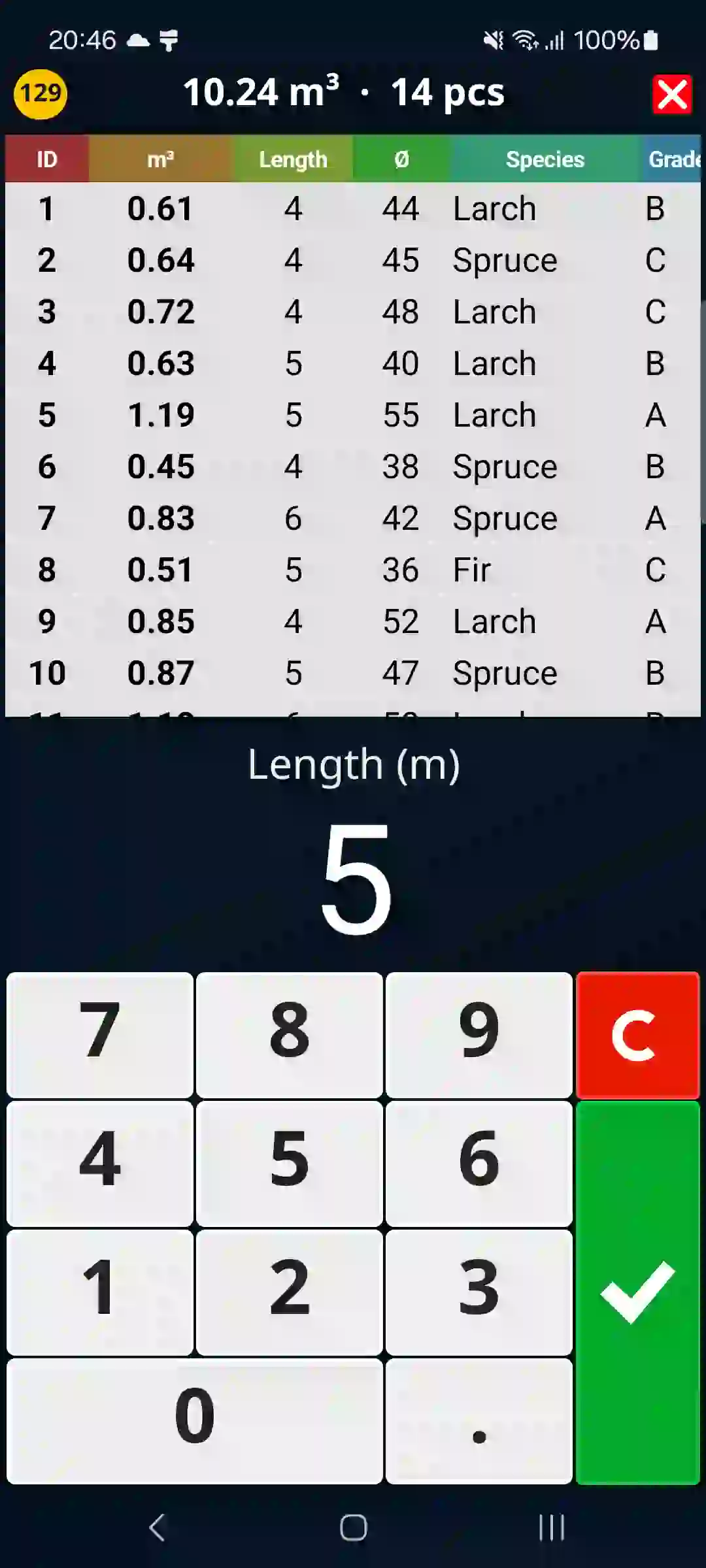
- A list of all measured logs with diameter, length, species and volume. In the app it is created by the Tally Recorder and can be printed or sent as a PDF.
- Timber transport document
- A document proving the origin and quantity of timber that accompanies each load. Many countries require it by forestry law.
- EUDR
- The EU Deforestation Regulation (2023/1115). Anyone placing timber on the EU market must show it does not come from deforested land and provide the geolocation of the plot of origin.
- Mid diameter
- The diameter of a log at half its length. The Huber formula uses it. Under the Czech ČSN 48 0009 standard it is measured over bark and the volume is read from the table under bark.
- Top diameter
- The diameter at the thinner end of a sawlog. The American Doyle, Scribner and International rules are based on it. It is a different quantity from the mid diameter, so the tables cannot be swapped. The Czech ČSN 48 0008 tables also use it.
- Log scaler
- A log scaler is a professional in the timber industry who measures, identifies and grades cut trees to determine their net volume and market value. With TIMBERPOLIS, a log scaler enters the diameter and length of each log and sees the volume straight away.
Methods with their own page
In your countryHoppus formulaA traditional British rule still used in the tropical hardwood and teak trade.m³ · GB · IE · IN · GH · MYHuber formulaThe most widely used scaling method in Central Europe: one diameter at mid-length and the length.m³ · SK · CZ · DE · AT · FR · IESmalian formulaWhen you cannot reach the middle of the log – on a deck or a truck – you measure both ends.m³ · US · CADoyle Log RuleThe oldest log rule still in wide use in the southern and midwestern United States.BF · USScribner Decimal CA rule built by drawing boards into circles, today the standard for softwood logs in the western United States.BF · US · CAInternational ¼″ Log RuleIt allows for a ¼-inch kerf, shrinkage and log taper, so it comes closest to the real sawn timber yield.BF · USJAS (Japanese standard)The small-end diameter squared method, the standard for logs traded to Japan.m³ · JPSwedish scaling (toppmätning)Swedish sawmills pay by the small-end diameter: m³to is a cylinder from the top end.m³ · SEMore methodsSTN 48 0009, ČSN 48 0009, Mid-girth, Newton, GOST 2708-75, Brereton, Vermont, Universal (Daniels), Ontario Board Foot, Ontario Cubic, Roy, Alberta, BC Firmwood, Guo Biao (GB/T 4814)All 22 methods ›