
 English (UK)
 English (US)
 Deutsch
 Français
 Italiano
 Español
 Português
 Nederlands
 Dansk
 Norsk
 Svenska
 Suomi
 Eesti
 Latviešu
 Lietuvių
 Polski
 Čeština
 Slovenčina
 Magyar
 Slovenščina
 Hrvatski
 Srpski
 Română
 Български
 Ελληνικά
 Türkçe
 Українська
 中文
 हिन्दी
 Русский
Doyle Log Rule – board feet from the small-end diameter
The oldest log rule still in wide use in the southern and midwestern United States.
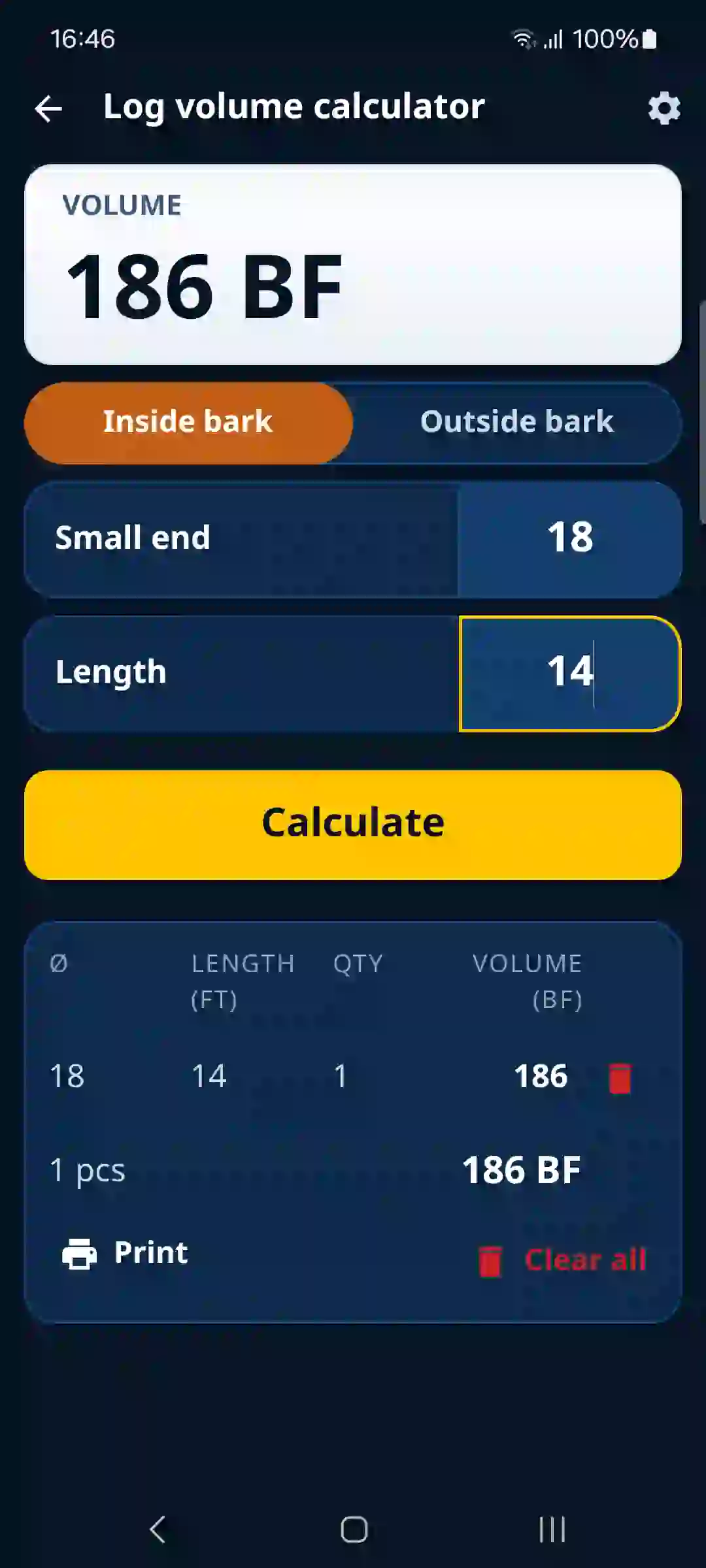
What is the Doyle Log Rule?
The Doyle log rule is a formula that estimates log volume in board feet (BF) from the small-end diameter inside bark in inches and the length in feet. It is simple, but it strongly underestimates lumber yield on small logs and overestimates it on very large ones.
Formula
BF = (D − 4)² · L / 16
D = small-end diameter inside bark in inches · L = length in feet. Diameters under 4 inches give 0. The 4-inch deduction stands for slabs and saw kerf.
Worked example
A log 16 inches at the small end and 16 feet long: BF = (16 − 4)² · 16 / 16 = 144 BF.
Where it is used
The southern and midwestern United States, hardwood log trade and many US sawmills.
Frequently asked questions
Why does Doyle scale small logs so low?
It deducts a fixed 4 inches from the diameter. On a small log that is a large share of the diameter, so the result is far below the real lumber yield.
What is the difference between Doyle and Scribner?
A 16″ × 16 ft log scales 144 BF by Doyle and 160 BF by Scribner. The gap shrinks as the diameter grows, and on very large logs Doyle gives more.
Does the app scale Doyle offline?
Yes. The app always scales logs offline, in board feet and in m³.