
 English (UK)
 English (US)
 Deutsch
 Français
 Italiano
 Español
 Português
 Nederlands
 Dansk
 Norsk
 Svenska
 Suomi
 Eesti
 Latviešu
 Lietuvių
 Polski
 Čeština
 Slovenčina
 Magyar
 Slovenščina
 Hrvatski
 Srpski
 Română
 Български
 Ελληνικά
 Türkçe
 Українська
 中文
 हिन्दी
 Русский
International ¼″ Log Rule – the most accurate board foot rule
It allows for a ¼-inch kerf, shrinkage and log taper, so it comes closest to the real lumber yield.
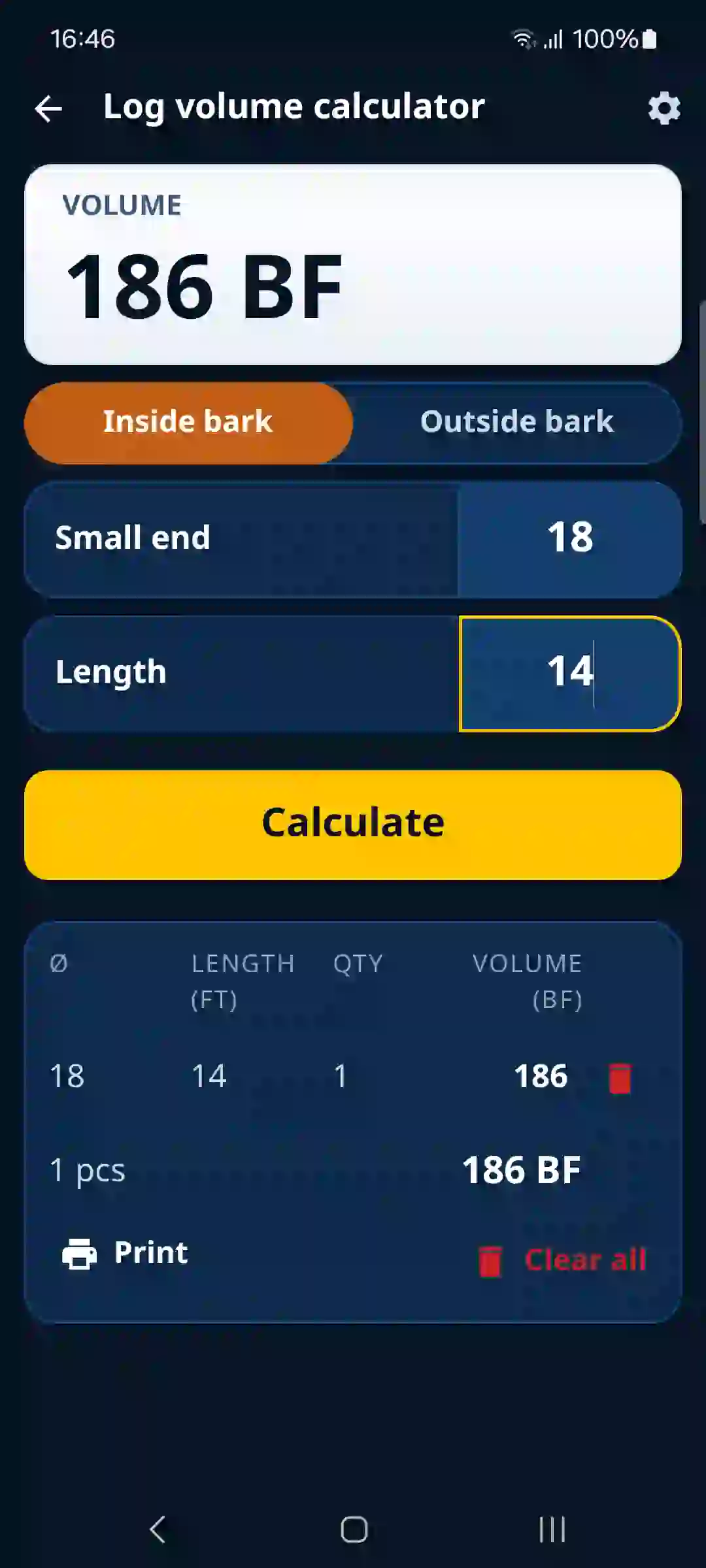
What is the International ¼″ Log Rule?
The International ¼-inch log rule is a formula for log volume in board feet that allows for a ¼-inch saw kerf, lumber shrinkage and a taper of ½ inch per 4 feet. Of the US log rules, it comes closest to the actual lumber yield.
Formula
BF = 0.04976191·L·D² + 0.006220239·L²·D − 0.1854762·L·D + 0.0002591767·L³ − 0.01159226·L² + 0.04222222·L
D = small-end diameter in inches · L = length in feet. This is the continuous form of the rule (Grosenbaugh); the official table rounds the result to the nearest 5 board feet.
Worked example
A log 16 inches at the small end and 16 feet long: the formula gives 180.6 BF, the table rounded to 5 BF lists 180 BF.
Where it is used
The north-eastern United States, several state agencies and the Forest Service in the East, research and forestry schools.
Frequently asked questions
Why is International ¼″ more accurate than Doyle?
It accounts for the real kerf, shrinkage and taper. Doyle deducts a fixed 4 inches, which badly distorts the result on small logs.
What does ¼ inch in the name mean?
The saw kerf width. There is also a ⅛-inch version, which gives higher numbers.
Is the result rounded?
The official table is – to 5 board feet. The calculator shows both the exact formula value and the rounded value.