
 English (UK)
 English (US)
 Deutsch
 Français
 Italiano
 Español
 Português
 Nederlands
 Dansk
 Norsk
 Svenska
 Suomi
 Eesti
 Latviešu
 Lietuvių
 Polski
 Čeština
 Slovenčina
 Magyar
 Slovenščina
 Hrvatski
 Srpski
 Română
 Български
 Ελληνικά
 Türkçe
 Українська
 中文
 हिन्दी
 Русский
Smalian formula – log volume from both end diameters
When you cannot reach the middle of the log – on a deck or a truck – you measure both ends.
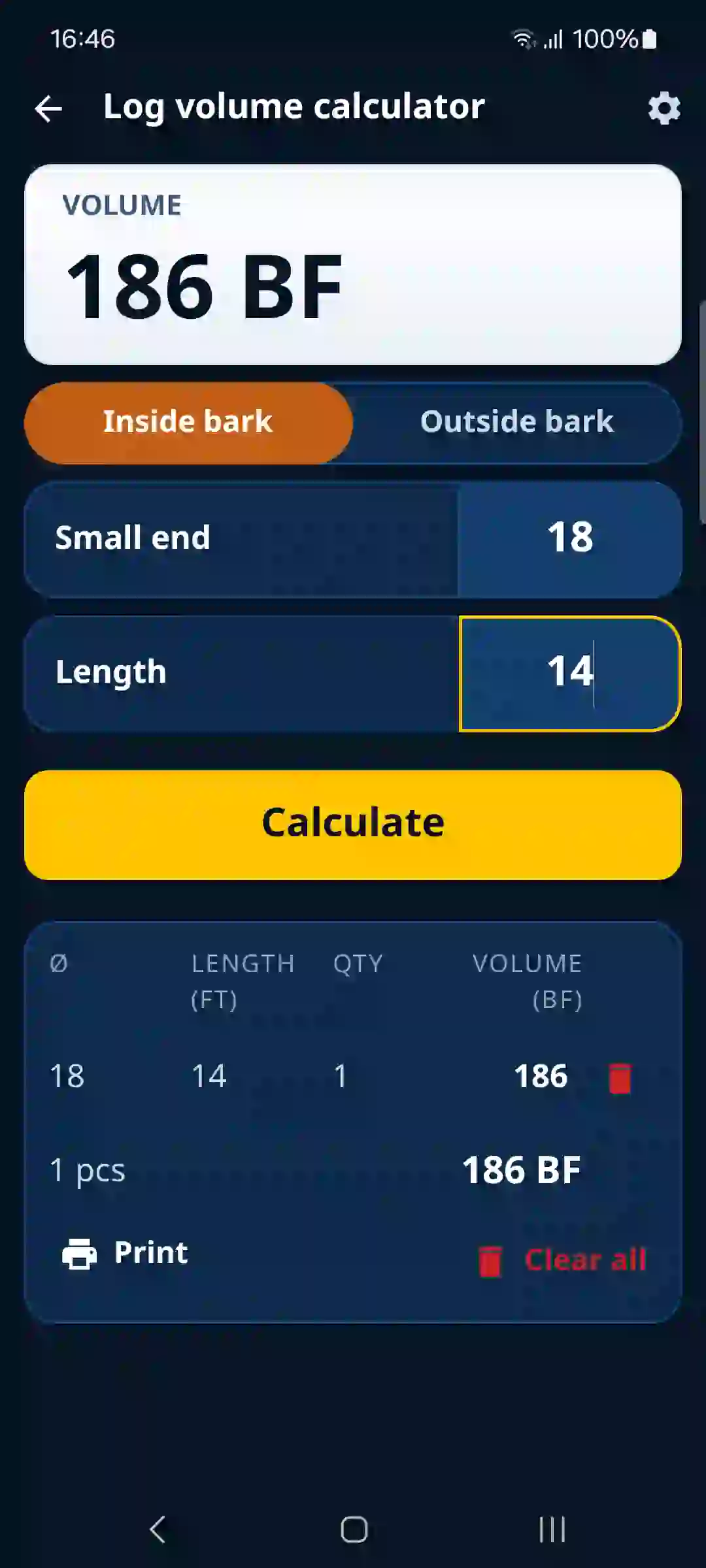
What is the Smalian formula?
The Smalian formula calculates log volume as the average of the two end cross-section areas multiplied by the length. Both measurements are taken on the log ends, which makes it practical for decked or loaded logs. On logs with strong taper it slightly overestimates volume.
Formula
V = (A₁ + A₂) / 2 · L
A₁, A₂ = cross-section area at the small and large end (π/4 · d²) · L = length. In imperial units: V [ft³] = 0.002727 · (D₁² + D₂²) · L, diameters in inches, length in feet.
Worked example
A log with 26 cm and 34 cm end diameters and 4 m length: A₁ = 0.0531 m², A₂ = 0.0908 m², V = (0.0531 + 0.0908) / 2 · 4 = 0.288 m³.
Where it is used
USDA Forest Service cubic scaling, Canada (Alberta, B.C. Firmwood) and anywhere logs are measured on the ends of a deck.
Frequently asked questions
Is Smalian more accurate than Huber?
Not always. On typical logs Smalian slightly overestimates and Huber slightly underestimates volume. Smalian's advantage is that it does not need the mid diameter.
When should I use Smalian?
When logs are decked and the middle cannot be reached, or when the buyer requires it, as is common in North America.
How does it differ from Newton's formula?
Newton's formula also includes the mid cross-section weighted by 4: V = (A₁ + 4·Aₘ + A₂)/6 · L. It is the most accurate but needs three diameters. The app calculates it too.